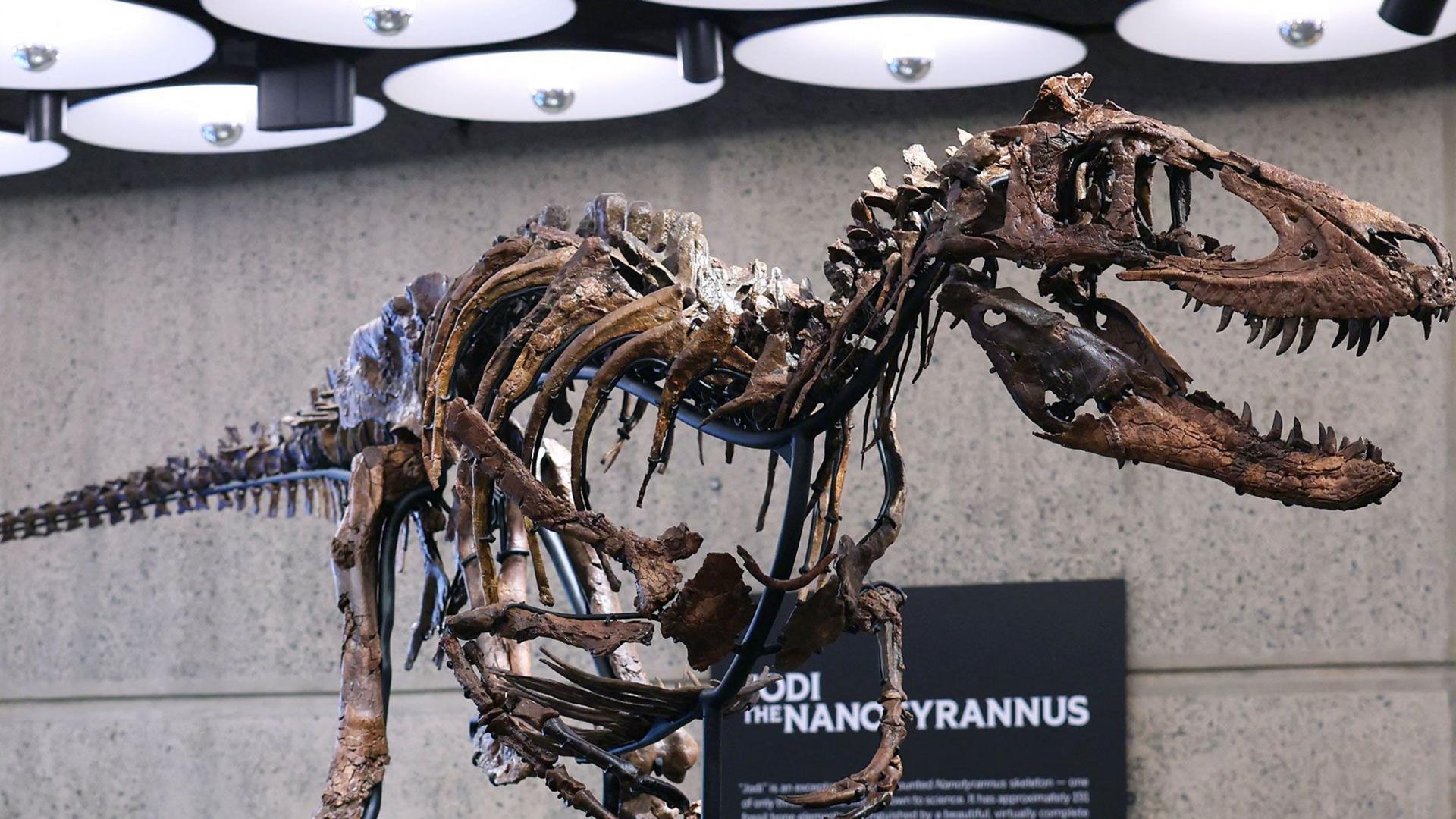
A mounted skeleton of Nanotyrannus, a small carnivorous dinosaur once mistaken for a juvenile Tyrannosaurus rex, sold at Sotheby's in New York for $47.3m on Tuesday. The skeleton, nicknamed "Jodi", far exceeded its expected price of at least $9m after bidding between six parties lasted 12 minutes. The buyer remains unnamed.
Jodi stands roughly 10 feet tall and contains about 191 fossil-bone elements with a nearly complete skull. Sotheby's noted it is one of only three known Nanotyrannus skeletons and the first to be sold since researchers confirmed the genus as distinct from T. rex in October last year.
The skeleton becomes the second-most valuable dinosaur fossil ever sold, behind a T. rex called "Gus" that fetched $50.1m in July. A Stegosaurus dubbed "Apex" sold for $44.6m in July 2024, making it third.
Megan Jenkins, a palaeontologist at the University of Portsmouth, explained that Nanotyrannus was "for a very long time believed to be sort of a teenager of T. rex". She noted the dinosaur is "a lot smaller and a lot more gracile" with "blade-like teeth for slicing through meat". Both species lived together roughly 67 million years ago during the Late Cretaceous period.
The skeleton was discovered on rancher Jodi Pierson's land in Montana's Hell Creek Formation and excavated by commercial palaeontologist Clayton Phipps, who also discovered the "Dueling Dinosaurs" fossil eight miles away. That specimen, showing what appears to be a Nanotyrannus and Triceratops in combat, proved crucial to research by Lindsay Zanno and James Napoli that classified Nanotyrannus as separate from T. rex, ending decades of scientific debate.
The auction reignites concerns among scientists about private fossil collecting. Steve Brusatte, a palaeontologist at the University of Edinburgh, called the sale "harrowing", saying the skeleton risks disappearing "into the vaults of a collector rather than displayed in a museum". He noted no museum or university can afford such prices and compared the situation to "the Mona Lisa" being privately owned.
Jenkins offered a counterpoint, saying excavation requires substantial time, effort and money, and that "a lot of them have ended up in the public eye" despite private sales. She expected Jodi "will end up in a museum at some point".